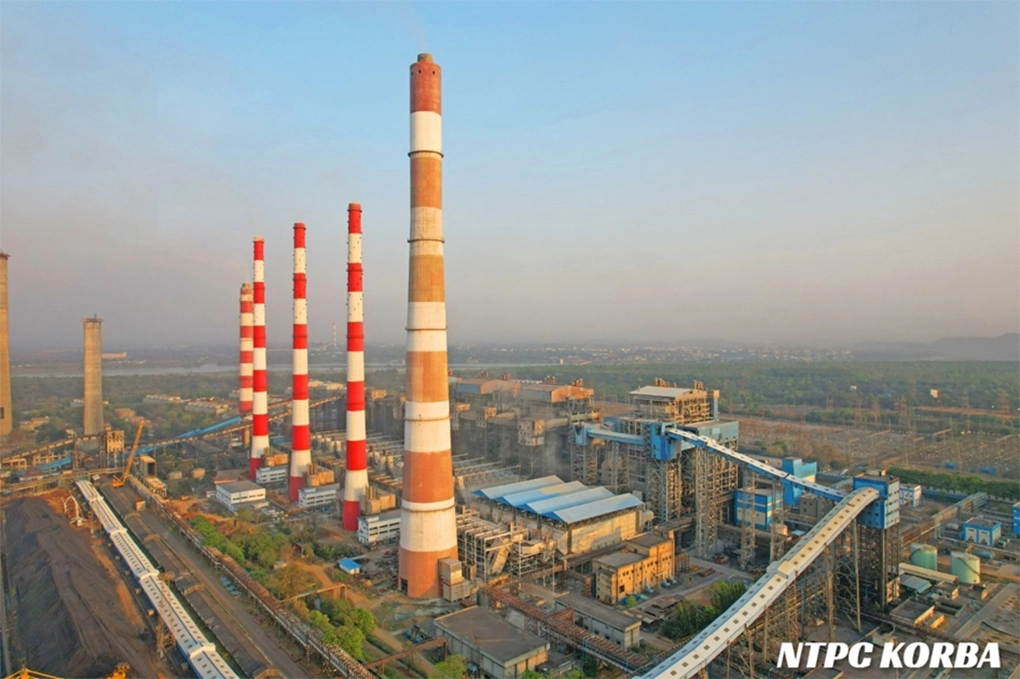

NTPC Limited
NTPC Limited is actively pursuing net-zero goals, aiming to make its townships and offices net-zero in Scope 2 emissions by FY 2025-26 and has a broader roadmap for net-zero GHG emissions. The greenhouse gas (GHG) emissions data for FY 2023-24 and FY 2022-23 are summarized as follows:
- Total Scope 1 Emissions: Increased from 335.72 million metric tonnes CO₂e in FY 2022-23 to 352.47 million metric tonnes CO₂e in FY 2023-24.
- Total Scope 2 Emissions: Remained constant at 0.07 million metric tonnes CO₂e in both financial years.
- GHG Emissions Intensity per Rupee of Turnover: Slightly improved, reducing from 0.000194654 tonnes/Rs in FY 2022-23 to 0.000188722 tonnes/Rs in FY 2023-24.
- GHG Emissions Intensity (Adjusted for PPP in USD): Decreased from 0.000709791 tonnes/USD in FY 2022-23 to 0.000688157 tonnes/USD in FY 2023-24.
Green Initiatives
- Natural Capital and Environmental Sustainability
- NTPC prioritizes environmental sustainability, surpassing global environmental standards.
- Achieved a 3.85% reduction in NOx emissions, an 8.56% increase in avoided GHG emissions, and a 10.74% increase in energy savings.
- Planted over 1 million trees during the year.
- Water & Effluent Management
- Follows the 3R principle (Reduce, Reuse, Recycle) to optimize water usage.
- Implements Zero Liquid Discharge (ZLD) in most stations to minimize environmental impact.
- Uses rainwater harvesting systems and an Ash Water Recirculation System (AWRS) to reduce freshwater withdrawal.
- 99.94% of generated wastewater was effectively recycled.
- Waste Management
- NTPC follows a structured approach to managing hazardous and non-hazardous waste.
- Achieved a 9% reduction in hazardous waste and a 3% reduction in non-hazardous waste.
- Project PRADIP has resulted in significant paper savings and enhanced operational efficiency.
- Single-use plastics have been completely banned across all facilities.
- Energy & Efficiency Management
Power Generation and Infrastructure
- Total installed capacity: 64 GW, with 3.26 GW added in FY 2023-24.
- Generation: Achieved an all-time high of 2 BU (5.75% YoY growth).
- Expansion into renewable energy, nuclear power, green hydrogen, and waste-to-energy projects.
Renewable Energy Transition
- NTPC aims to commission 60 GW of renewable energy (RE) capacity by 2032.
- 5 GW of RE capacity commissioned in FY 2023-24, including 3.3 GW solar, 213 MW wind, and 32 MW small hydro.
- NTPC is developing Ultra Mega Renewable Energy Power Parks (UMREPPs) in Gujarat, Madhya Pradesh, and DVC.
- Focus on energy storage: 4 GW/24 GWh capacity planned, including BESS and Pumped Storage Hydro systems.
Fuel and Resource Security
- Coal sourcing: Long-term agreements with CIL (214.45 MMT) and SCCL (27.99 MMT); 2 MMT produced from captive mines.
- Gas sourcing: Agreements with GAIL; procuring RLNG and Spot LNG.
- Biomass co-firing: Pioneered in India, awarded contracts for 28 million MT biomass pellets.
Nuclear Energy
- NTPC-NPCIL JV (ASHVINI) developing Mahi Banswara (4×700 MW) nuclear plant.
- Exploring small modular reactors (SMRs) and uranium sourcing with UCIL.
Green Hydrogen & Chemicals
- First Green Hydrogen Blending project in Kawas, Gujarat.
- Hydrogen mobility projects: Fuel Cell Electric Vehicles (FCEVs) in Leh and Delhi NCR.
- Developing Green Hydrogen hub in Andhra Pradesh for methanol and ammonia production.
Waste-to-Energy and Ash Management
- 600 TPD Waste to Charcoal Plant commissioned in Varanasi, preventing 7 lakh MT CO2 emissions annually.
- Contracts awarded for WtE plants in Bhopal, Hubballi Dharwad, Noida, and Gorakhpur.
- 92% fly ash utilization, supplying to cement, road construction, and mine reclamation.
- FGD gypsum sales started, reducing reliance on imported gypsum.
- Air Quality and GHG Emissions
- Equipped with Continuous Emission Monitoring Systems (CEMS) to track pollutants.
- Installed Flue Gas Desulfurization (FGD) systems in 23 units, with ongoing installation in 119 more.
- Scope 1 emissions increased due to additional thermal capacity, but specific emissions intensity decreased.
- Scope 3 emissions have been reduced due to decreased coal imports.
- Climate Change Mitigation
- Actively diversifying into renewable energy, nuclear energy, green hydrogen, and biofuels.
- Planted over 39 million trees since 2016 to build carbon sinks.
- 8 renewable energy (RE) projects registered under the Clean Development Mechanism (CDM), and 32 projects (6,702 MW) under the Global Carbon Council (GCC).
- Biodiversity Conservation
- NTPC’s projects are not located in protected areas, but some existing stations now fall within eco-sensitive zones due to new declarations.
- Key conservation projects:
- Protection of Gangetic Dolphin, Great Indian Bustard, Black Buck, Olive Ridley Turtles.
- Wildlife Conservation Plan for Sloth Bear and biodiversity mapping at power stations.
- Mangrove afforestation and compensatory afforestation with ₹7.78 Cr allocated to conservation efforts.
- Compliance & Environmental Training
- NTPC stations are ISO 14001 certified.
- Undertakes renovation and modernization (R&M) to ensure compliance with environmental standards.
- Conducts environmental training programs on waste management, water conservation, and biodiversity protection.
To know more, visit –