
GAIL (India) Limited
Commitment to Sustainability & Net-Zero Goals
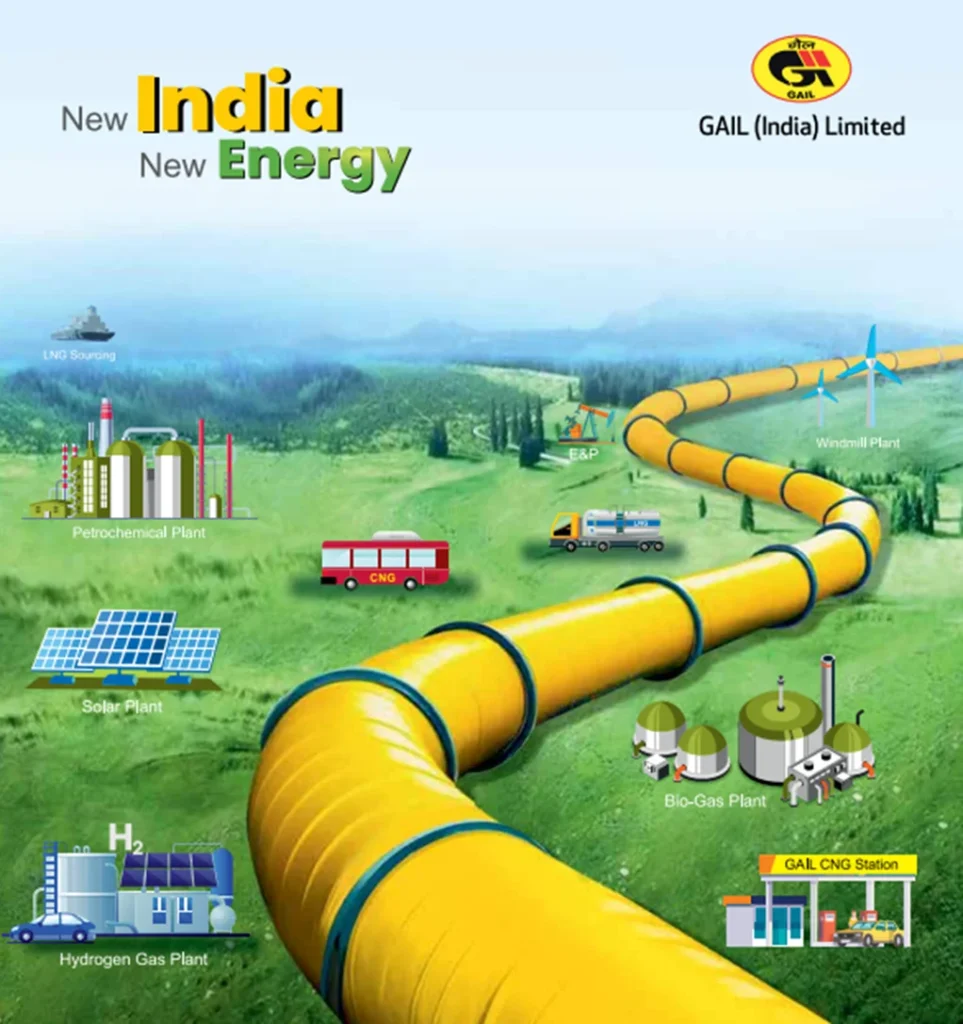
- GAIL aims to become an integrated energy company while ensuring long-term sustainability.
- In FY24, Scope 1 emissions (direct emissions from owned or controlled sources) amounted to 3,467,989 metric tons of CO₂ equivalent, a decrease from 3,656,175 metric tons in FY23.
- Scope 2 emissions (indirect emissions from purchased electricity) were 386,108 metric tons of CO₂ equivalent in FY24, increasing from 319,380 metric tons in FY23.
- It has set a Net Zero roadmap, targeting:
- 100% reduction in Scope 1 & Scope 2 emissions by 2035
- 35% reduction in Scope 3 emissions by 2040
- The company integrates Environmental, Social, and Governance (ESG) aspects into its operations and supply chain.
Key Sustainability Initiatives (FY 2023-24)
- Net-Zero Strategy Development:
- Conducted a detailed science-based study to formulate a Net-Zero action plan.
- Signed an MoU with IIT Bombay’s CoEOGE for a study on decarbonization of petrochemical and gas processing industries.
- Carbon Capture & Renewable Energy Investments:
- Participated in a sectoral study on Carbon Capture, Utilization, and Sequestration (CCUS) with FIPI.
- Partnered with TruAlt Bioenergy Limited (TBL) to set up 10 Compressed Biogas (CBG) plants with INR 600 crore investment.
- Invited proposals for a Municipal Solid Waste (MSW)-based CBG plant joint
Sustainability Achievements
- Upgraded from “C” to “B” level in the CDP Global ESG Rating (Climate Change category).
- Included in the FTSE4Good Index, recognizing strong ESG practices.
Monitoring & Performance Tracking
- Digital Dashboards:
- Real-time monitoring of energy users (SEUs) like steam turbines, boilers, and heat recovery systems to optimize efficiency.
- Use of e-Sustainability Module and BRSR Module for tracking sustainability performance.
GreenCo Certification & Sustainable Operations
- GreenCo Rating System implemented across operational sites to enhance sustainability in products, services, and operations.
- Dabhol-Bengaluru Pipeline awarded GreenCo Platinum Rating, marking GAIL’s first pipeline unit to achieve this level.
- Other GreenCo-certified sites: Vijaipur, Vaghodia, Pata, VSPL, Gandhar, and Jhabua.
GAIL’s sustainability approach reflects its strong commitment to net-zero emissions, clean energy investments, carbon reduction technologies, and operational efficiency improvements while aligning with India’s long-term climate goals.
Summary of GAIL’s Energy and Environmental Initiatives
Energy and Environment Commitment
GAIL integrates energy efficiency and environmental stewardship into its core values. It follows sustainability policies, assesses environmental impact across its value chain, and implements proactive strategies to reduce its footprint. The company also aligns with Mission LiFE, an initiative by the Government of India promoting sustainable living.
Governance and Policy on Energy and Environment
GAIL follows a holistic approach to energy conservation and environmental protection. Its sustainability policy balances economic, social, and environmental factors, with responsibility assigned to Officer-In-Charge (OICs) and HoDs. The company adheres to Standard Operating Procedures (SOPs) and guidelines to minimize environmental impact.
Biodiversity Management
GAIL prioritizes biodiversity conservation and follows a mitigation hierarchy (avoid, minimize, restore, offset) to reduce its impact. It avoids operations near ecologically sensitive areas and conducts Environmental Impact Assessments (EIA) before new projects. GAIL contributes to afforestation through Compensatory Afforestation (CAMPA) for forest-area pipeline projects.
- Biodiversity initiatives:
- Pata Plant: 160 acres of green cover, butterfly park, 1.54 lakh trees planted in FY 2023-24.
- Vijaipur Plant: 321 acres of greenbelt, 6,331 trees planted in FY 2023-24.
Energy Management
GAIL implements energy-efficient technologies to reduce greenhouse gas emissions. All major installations are ISO 50001 certified, aligning with energy efficiency standards.
- Key Energy-Saving Initiatives:
- Pata Plant: Upgraded motors, ACs, and lighting, saving ~3.37 lakh kWh in FY 2023-24.
- Hazira Plant: Replaced conventional lighting with LEDs, saving ~3.45 lakh kWh annually.
- Gandhar Plant: Installed energy-efficient ACs, saving ~10,208 kWh and reducing 8 tCO2e emissions.
Emission Management
GAIL follows ISO 14064-2018 and API-2022 standards for GHG emissions control. It monitors emissions via a cloud-based system linked to pollution control boards and implements Leak Detection and Repair (LDAR) programs to reduce methane leaks.
Water Management
GAIL adopts sustainable water management practices, including rainwater harvesting, wastewater recycling, and third-party water audits. In FY 2023-24, it withdrew 22.49 million m³ of water, with minimal reliance on groundwater.
- Water-saving initiatives:
- Pata Plant: 9.75 lakh m³ of rainwater harvested in FY 2023-24.
- Zero Liquid Discharge: Most GAIL facilities treat and reuse wastewater for horticulture.
GAIL’s comprehensive energy, environment, and sustainability efforts align with India’s climate goals, contributing to SDGs 14 (Life Below Water) and 15 (Life on Land) while maintaining operational excellence.
Responsible Waste Management
GAIL has a comprehensive waste management system that aligns with the 3R strategy (Reduce, Reuse, Recycle) to minimize hazardous and non-hazardous waste. The company conducts environmental audits (internal and external) to ensure compliance with regulations, with no adverse impact reported on business operations.
- Extended Producer Responsibility (EPR):
- Complies with the Plastic Waste Management Rules 2022.
- GAIL Pata is registered as a Brand Owner, Importer, and Producer of polymers under CPCB and UPPCB regulations.
- EPR targets are met by procuring EPR certificates.
- Hazardous & E-Waste Management:
- Battery waste is recycled through authorized agencies.
- E-waste is disposed of as per regulatory procedures.
- Circular Economy & Waste Management Initiatives:
- GAIL Pata: Maintains hazardous waste records as per regulations, with dedicated waste management procedures, authorized disposal channels, and regular e-waste collection drives. Key achievements include:
- 3,200 tons of waste/scrap recycled.
- 80 tons of organic waste converted into compost for horticulture.
- Other Facilities:
- Gandhar: Authorized hazardous waste disposal, biomedical waste segregation, and e-waste management.
- Kandla, Abu Road, Mansarampura: Authorized disposal of used oil, scrap, and biodegradable waste.
- GAIL Pata: Maintains hazardous waste records as per regulations, with dedicated waste management procedures, authorized disposal channels, and regular e-waste collection drives. Key achievements include:
Research & Development (R&D) Initiatives
GAIL integrates R&D and innovation into its business processes to enhance sustainability and environmental management. The focus areas include pipeline integrity, biogas, polymers, catalysts, fuel cells, CO₂ utilization, and waste management.
- Key R&D Projects:
- E-methane Production: Developing catalysts for CO₂ hydrogenation to produce synthetic natural gas in collaboration with CSIR-IIP Dehradun.
- Hydrogen Production: Developing cost-effective electrocatalysts for PEM electrolysis with CeNS Bengaluru.
- PEM Fuel Cells: Working with CeNS Bengaluru and IOCL for indigenous fuel cell development with reduced platinum usage.
- Hydrogen Storage: Researching Liquid Organic Hydrogen Carriers (LOHCs) with CSIR-NCL for safe hydrogen storage.
- Solar Cooking System: Developing clean cooking prototypes with CSIR-CMERI and CSIR-CEERI.
- Patents & Intellectual Property:
- 2 new Indian patents filed, with a total of 32 granted patents.
- A copyright was filed for an AC-induced corrosion rate estimator for underground pipelines.
- R&D Expenditure:
- INR 250.20 Crores allocated in FY 2023-24, with INR 20.36 Crores for collaborative research and INR 229.84 Crores for innovation initiatives.
- GAIL consistently allocates ~2% of Profit Before Tax (PBT) to R&D.
These initiatives reinforce GAIL’s commitment to sustainability, technological advancement, and environmental stewardship.
Summary of GAIL’s Net Zero Action Plan
Operational Decarbonization
GAIL is reducing its Scope 1 & 2 emissions through energy efficiency, fuel switching, and electrification:
- Energy Efficiency Measures:
- Waste Heat Recovery at Gandhar, Flare Gas Recovery at Vijaipur, and venting-to-fuel unit projects.
- Upgrading equipment: IE-3 motors, energy-efficient air conditioners, LED lighting.
- Transitioning 686 MW NG-based equipment to electric by 2035.
- Renewable Energy Expansion:
- Total installed RE capacity of 135 MW (118 MW Wind, 17 MW Solar).
- Solar projects in Pata (15 MW), Vijaipur (10 MW, 1.8 MW, 7.75 MW), and UP (100 MW).
- 170 MW Wind project in Usar under tendering.
Energy Transition
GAIL is focusing on clean energy solutions to phase out natural gas and lower emissions:
- Green Hydrogen:
- 10 MW Green Hydrogen Electrolyzer operational in Vijaipur.
- Hydrogen blending in CGD networks increased to 5%.
- Targeting 310 MW Electrolyzer capacity to produce 45 KTA Green Hydrogen by 2030.
- Biofuels & CBG:
- Setting up a 500 KLPD grain-based ethanol plant in Rajasthan.
- 26 CBG plants planned by 2030, including a 5 TPD CBG plant in Ranchi.
- Signed agreement to establish 10 CBG plants with TruAlt Bioenergy Limited.
- Battery Energy Storage System (BESS):
- Targeting 1,000 MWh BESS capacity and 100 MW Renewable Energy for BESS by 2035.
Carbon Capture, Utilization & Storage (CCUS)
GAIL is investing in CO2 capture and utilization technologies to reduce Scope 1 & 3 emissions:
- Pilot projects:
- CO2 to Methanol & DME (IIT Delhi).
- CO2 to Syngas (IIP Dehradun).
- CO2 to Polycarbonate Diol (IISER Tirupati).
- Micro-Algae for CO2 fixation.
- Targeting 2,500 TPD CO2 abatement through CCUS valorization.
Offsetting & Nature-Based Solutions
- Planted 3,53,487 trees in the last two years, including 1.5 lakh Miyawaki trees.
- Targeting 1 lakh trees annually for carbon offsetting.
Key Enablers for Net Zero
- Governance & Policy Alignment: Regular reviews by the Sustainable Development Committee.
- Sustainable Finance: Investing in green bonds, ESG-linked loans, and carbon markets.
- Digitalization: Real-time emission tracking, energy efficiency monitoring, and AI-based leak detection.
- Internal Carbon Pricing: Setting an internal carbon cost to guide sustainable investment decisions.
Conclusion
GAIL is aggressively pursuing Net Zero by 2035 through renewable energy, hydrogen, biofuels, CCUS, and carbon offsetting while aligning with India’s clean energy transition and global climate goals.
To know more, visit –