
Power Finance Corporation Limited
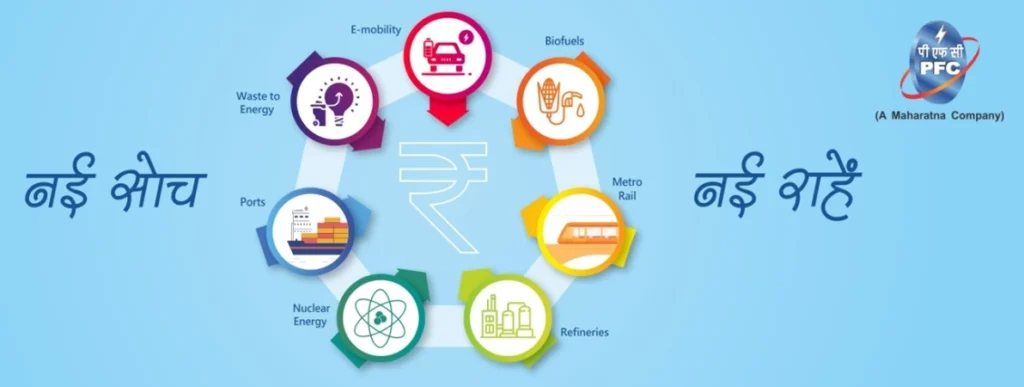
The Power Finance Corporation (PFC) plays a key role in India’s clean energy financing by supporting renewable energy (RE), e-mobility, energy efficiency, and sustainable infrastructure.
Key Achievements in Renewable Energy Financing:
- ₹1 lakh crore disbursed for RE projects.
- ₹60,208 crore RE loan book with a 16% CAGR over five years.
- ₹2.37 lakh crore MoUs signed for clean energy projects.
- 50 GW RE capacity financed, accounting for 25% of India’s total non-fossil fuel capacity.
Green Financing & Global Collaborations
Domestic Financing for Clean Energy:
- PFC provides low-interest loans (1.0-1.5% lower than conventional power projects) to accelerate clean energy adoption.
- Dedicated financing for solar, wind, hydro, energy efficiency, and e-mobility projects.
- Streamlined approval processes with web-based loan applications & standard documents for solar projects.
International Green Finance Initiatives:
PFC has successfully raised green finance through bonds, credit lines, and partnerships with global institutions:
- Euro Green Bond (€300 Mn, 2021) – First Euro-denominated green bond from India.
- USD Green Bond ($400 Mn, 2017) – Listed on London & Singapore stock exchanges.
- Japan Bank for International Cooperation (JBIC) Credit Line (JPY 30 Bn, 2022) under the GREEN initiative.
- MoU with Japan’s NEDO for technology innovation in power voltage transformers & optimized energy distribution.
- MoU with USAID’s SAREP program for ESG framework & capacity building.
- MoU with Council on Energy, Environment, and Water (CEEW) to support offshore wind, battery storage, green hydrogen, and CCUS.
- MoU with Govt. of Goa & World Bank to create a Blended Finance Facility for renewable energy, green hydrogen, EVs, and nature-based solutions.
Major Sustainable Development Projects
- a) E-Mobility Financing
- ₹633 crore loan sanctioned to Gensol Engineering Ltd. for 5,000 electric four-wheelers and 1,000 electric three-wheelers.
- BluSmart Mobility to deploy these vehicles for ride-hailing and urban delivery.
- Estimated impact:
- 1,500+ million km driven by EVs.
- 1.13 lakh tonnes CO₂ emission reduction, equivalent to CO₂ absorbed by 51.5 lakh trees annually.
- b) Energy Efficiency – LED Streetlighting in Maharashtra
- ₹35 crore project in Sangli, Miraj, and Kupwad to replace streetlights with smart LED systems.
- Key features:
- IoT-based Centralized Control Monitoring System (CCMS) for remote operation.
- Wireless communication technology for lamp control.
- Expected impact:
- 84.5% energy savings.
- Reduction of 20,000 metric tonnes of CO₂, equal to CO₂ absorption by 9.24 lakh trees.
- c) Waste-to-Energy (WTE) – Maharashtra’s First Integrated WTE Project
- ₹172 crore sanctioned to Antony Lara Renewable Energy Pvt. Ltd. for a 14 MW WTE plant in Pimpri-Chinchwad, Pune.
- Key features:
- 700 TPD non-recyclable waste converted into electricity through controlled incineration.
- Recycled water from Chikali Sewage Treatment Plant used (no freshwater needed).
- Estimated impact:
- 7 lakh tonnes of CO₂ avoided annually, equivalent to emissions from 1.5 lakh passenger cars.
- Electricity for Pimpri-Chinchwad Municipal Corporation’s (PCMC) sewage & water pumping facilities.
- d) Water Recycling & Wastewater Treatment
- ₹530 crore sanctioned for Nagpur (200 MLD) & Chandrapur (70 MLD) wastewater treatment projects.
- Key benefits:
- Treated water used for power plant cooling, reducing freshwater dependency.
- 240 MLD freshwater made available for residents.
- Supports agriculture and food security by preventing power plant shutdowns.
- e) Gujarat Desalination Plants – Addressing Water Scarcity
- ₹1,156 crore financing for four desalination plants (270 MLD capacity) in Kutch, Dwarka, Somnath, and Bhavnagar.
- Expected benefits:
- Freshwater for 5.5 lakh households.
- Cost savings for Gujarat on water supply (₹40-45/KL vs. ₹65-70/KL from the Sardar Sarovar Dam).
- Potential industrial use of brine generated.
Environmental & Sustainability Actions
Waste Management Initiatives
- Organic Composting:
- Installed 50 kg capacity composting machine at PFC office.
- Converts 90% of organic waste into compost for plantation use.
- E-Waste Disposal:
- IT waste responsibly recycled through CPCB-registered vendors.
- Plastic Reduction:
- Minimal plastic usage, promoting jute/cloth bags & paper folders.
Digital Sustainability
- Paperless work culture with e-office, digital board meetings, and collaboration tools to reduce carbon footprint.
Impact of PFC’s Clean Energy Investments
Renewable Energy Portfolio – CO₂ Reduction Impact
- CO₂ Emission Avoidance:
- 885 lakh tonnes of CO₂ avoided annually, equivalent to the absorption by 354 crore trees.
- Breakdown of RE projects financed:
- Wind: 6,699 MW
- Solar: 11,861 MW
- Hybrid (Solar & Wind): 1,959 MW
- Waste-to-Energy: 207 MW
- Small Hydro: 694 MW
- Large Hydro: 27,815 MW
To know more, visit –